Sound & number · 4 min read
What is the Fibonacci frequency?
The numbers behind a 33-minute climb from 55 to 987 Hz: what Fibonacci frequencies are, what the golden ratio has to do with them, and how to listen.
Our most-listened piece is a 33-minute journey called Fibonacci Ascension. People often ask what the name means, and whether a “Fibonacci frequency” is a real thing. The short answer is that it is a way of choosing notes, and a way of shaping time. Here is how it works.
A row of numbers that grows like a plant
The Fibonacci sequence starts with 1 and 1. Every next number is the sum of the two before it: 1, 1, 2, 3, 5, 8, 13, 21, 34, 55, 89, 144, 233, 377, 610, 987. The Italian mathematician Leonardo of Pisa, known as Fibonacci, wrote it down in the year 1202.
You can count these numbers in nature. Sunflower seeds lie in two sets of spirals, often 34 one way and 55 the other. Pine cones and pineapples show the same habit. And the further you go along the row, the closer each number divided by the one before it comes to 1.618, the golden ratio, written with the Greek letter Φ (phi).
From numbers to sound
Sound is vibration, counted in hertz (Hz): the number of waves per second. A tone of 55 Hz is a deep hum. 987 Hz is a clear, high note. In Fibonacci Ascension every chapter is tuned to a Fibonacci number, so the music climbs through seven steps:
- 55 Hz · Seed · 1 minute
- 89 Hz · Sprout · 1 minute
- 144 Hz · Spiral · 2 minutes
- 233 Hz · Shell · 3 minutes
- 377 Hz · Sunflower · 5 minutes
- 610 Hz · Galaxy · 8 minutes
- 987 Hz · Infinity · 13 minutes
Look at the minutes: 1, 1, 2, 3, 5, 8, 13. Those are Fibonacci numbers too, and together they make 33. Each chapter is as long as the two before it combined, so the piece opens slowly, like a spiral. That is why the last, highest chapter fills more than a third of the journey: by then the ear has settled, and there is time to stay.
Because each tone is about 1.618 times the one before it, every step up sounds like the same interval: a little wider than a minor sixth. The ear hears a staircase with equal steps.
 Fibonacci Ascension · 55 to 987 HzListen to the full 33 minutes on YouTube ↗
The heart of the piece: the binaural frequency
The heart of the piece is a binaural beat. Each ear hears a slightly different tone, and the brain notices the difference as a slow, gentle pulse. This frequency is the base of every track we make: our intention with it is to bring your vibration back to its natural state. The Singing Bowls come on top, to loosen what feels stuck. In this piece the difference follows the golden series as well, moving down from Φ⁴ (about 6.9 Hz) to Φ (1.618 Hz) while the tones climb. A binaural beat only exists when each ear gets its own tone, so this part needs headphones. Over speakers you still hear the music, only without the pulse.
What it does, and what it does not
We would rather be honest than impressive. What we describe here is our approach and our intention, not a medical effect: no frequency has been shown to heal anything, and we do not claim that this one does. What slow, steady sound can do is simple and well known to anyone who has sat by the sea: it gives a busy mind something calm to rest on. The Fibonacci shape is how we chose to build that calm, the way a composer chooses a key.
How to listen
- Use headphones if you want the binaural pulse, and keep the volume low.
- Sit or lie down, and let the first two short minutes be your arrival.
- Follow the climb. Many listeners tell us one step feels like home; notice which one is yours.
- For sleep, start it as the last thing in your evening, with the screen turned face down.
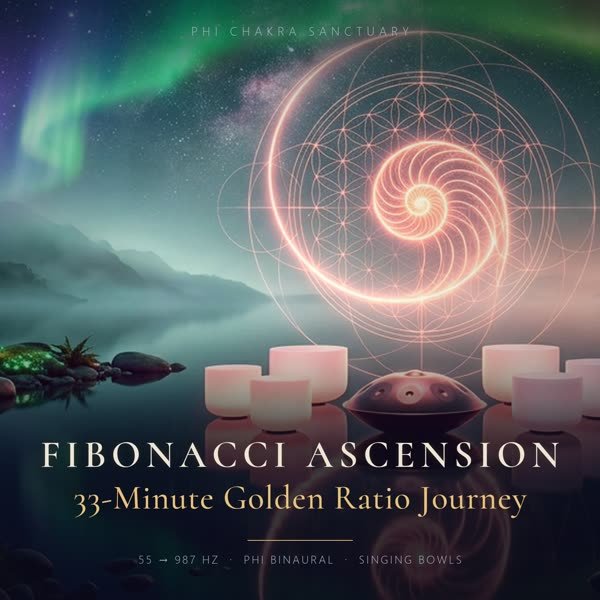
Fibonacci Ascension, 33 minutes
The full climb from 55 to 987 Hz as a file you keep. Play it on any device, as often as you like, with nothing interrupting it.
Download the track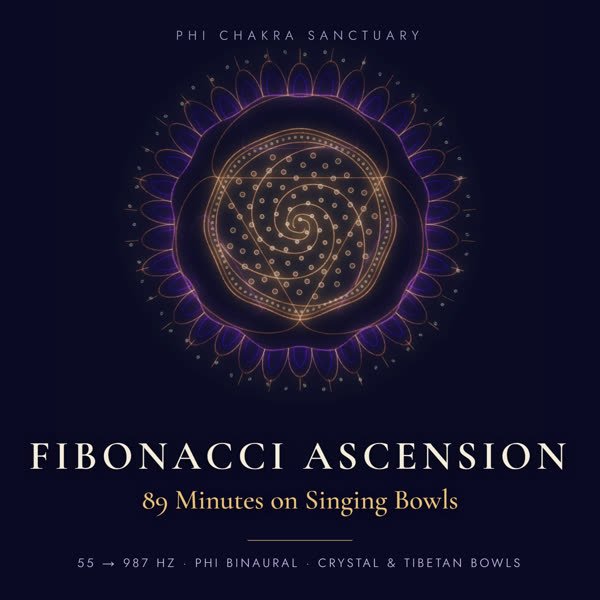
Fibonacci Ascension, 89 minutes on Singing Bowls
The same seven steps, stretched to 89 minutes for a long meditation or the first part of the night.
Download the trackIf you listen in bed, soft headband headphones are far kinder than earbuds.
Some links on this page go to Amazon. As an Amazon Associate we earn from qualifying purchases, at no extra cost to you.
Rather just press play?
Stream the music from our shop without adverts, on any device, with a sleep timer. We are building it now.
A new sound journey every evening
Subscribe on YouTube and your evening routine never runs out. No talking, no sudden sounds.
Subscribe on YouTube ↗